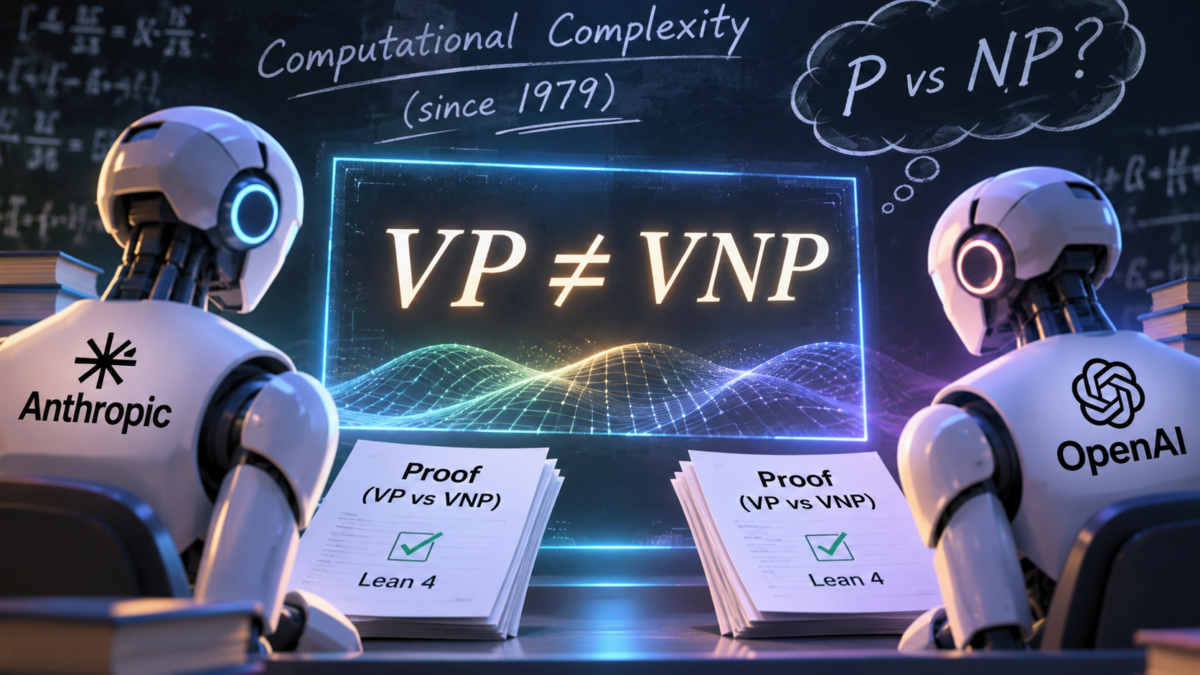
AI math breakthrough, Digimart Global: Anthropic and OpenAI have independently released mathematical proofs addressing the same long-standing problem in computational complexity theory, a development that could mark a significant milestone for AI-assisted research. Both companies published their findings on the VP versus VNP problem, which was introduced by mathematician Leslie Valiant in 1979.
The problem is closely related to the well-known P versus NP question, though the results still need careful examination by human mathematicians before they can be accepted as established work.
What Anthropic published
Anthropic quietly published its findings on GitHub, reporting a proof that VNP is not contained within VP. According to the source, the work was produced by an internal research version of its Claude AI model, which also wrote the accompanying paper and a formal verification of the proof.
Anthropic acknowledged that no human mathematician had yet reviewed the proof.
The proof was formalized using Lean 4, a programming language designed for mathematical verification. Formalization translates a mathematical argument into computer code that can be checked systematically, which helps verify the logical steps of an argument even though the mathematical claims themselves still require independent scrutiny.
OpenAI’s competing paper
OpenAI published its own paper on the same problem on GitHub later the same day, also including a formalization in Lean 4. The two proofs differ in several important respects, although both papers argue that VP is not equal to the broader class VNP. According to the upload timestamps cited in the report, Anthropic’s submission appeared about six hours before OpenAI’s.
Both papers approach the problem differently but aim to establish that certain mathematical computations cannot be performed efficiently using relatively small arithmetic circuits.
Why the problem matters
The goal of this research is to show that some computational problems are fundamentally harder than others and cannot be solved efficiently, regardless of how clever an algorithm might be. Proving that a problem is intrinsically hard is considerably more difficult than showing it can be solved quickly, because it requires demonstrating that no sufficiently efficient algorithm exists.
VP versus VNP is an algebraic counterpart to the better-known P versus NP problem. Both concern the difficulty of solving computational problems, but VP and VNP describe complexity classes involving mathematical computations over polynomials rather than conventional binary logic.
P versus NP asks whether every problem whose solution can be checked efficiently can also be solved efficiently, and a proof either way would have major implications for computing, optimization and cryptography.
Researchers respond with caution
Tom Gur of the University of Cambridge described the progress as unprecedented, saying decades of mathematical work appeared to have advanced within days. He stressed, however, that the mathematical community needs more time to study the proofs and determine how broadly their techniques can be applied.
Varun Kanade of the University of Oxford said the results could bring researchers closer to solving P versus NP, but that new techniques will probably still be necessary. Ben Livshits of Imperial College London noted that the rapid progress raises broader questions about the future of theoretical computer science and the role of AI in mathematical research.
The announcements follow other recent claims of major AI-linked mathematical breakthroughs, including a reported proof of the Riemann hypothesis. Independent verification will be essential before either result can be considered an established mathematical breakthrough.