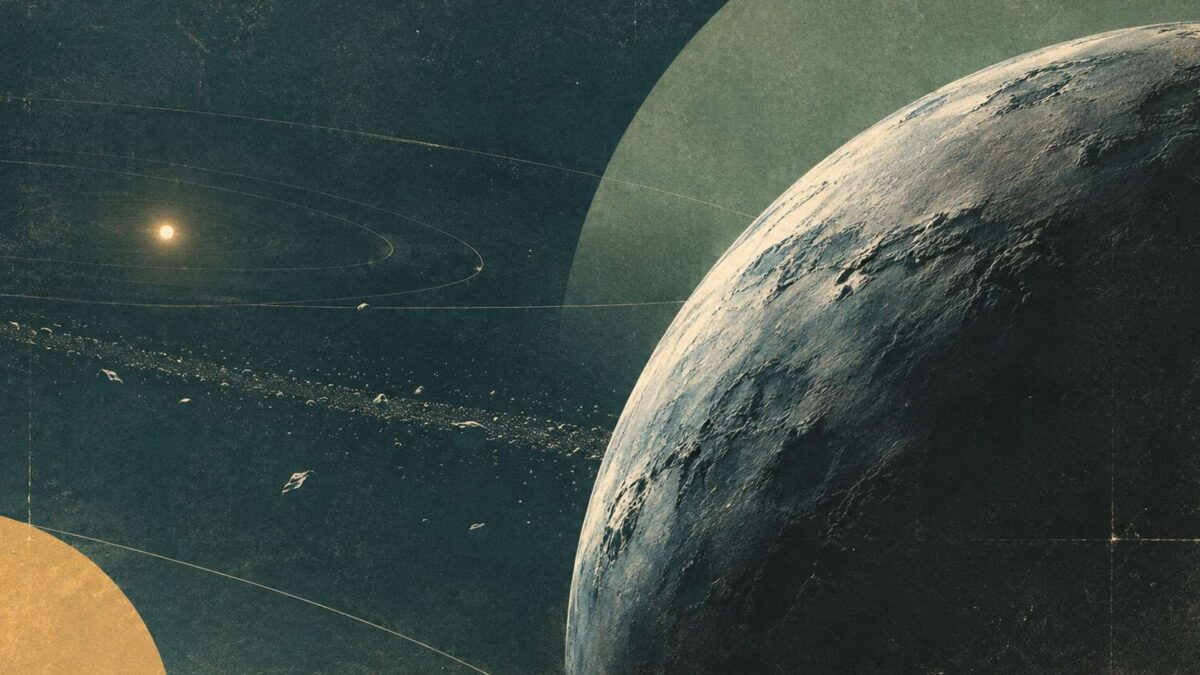
Planet X2 hypothesis, Digimart Global: Astronomers have proposed that an unknown planet, about 1.5 to 2 times the mass of Earth, may lie far beyond Neptune at the edge of the Solar System. The idea, called Planet X2 (PX2), was described in a study published in the Monthly Notices of the Royal Astronomical Society (MNRAS) by a team led by Patryk Sofia Lykawka of Kindai University in Japan and the University of Southern Queensland in Australia.
The proposal is aimed at explaining irregularities seen in the orbits of some distant objects in the Kuiper Belt and beyond Neptune. Many of these bodies follow highly elongated orbits and sit outside the average orbital plane of the Solar System, which the researchers say is hard to explain without a massive unseen perturbing body.
To test the idea, the team ran numerical simulations of the Solar System’s evolution over the past 4.5 billion years, including a migration of Neptune. According to the report, these simulations reproduce several of the observed orbital anomalies when PX2 is assumed to have a semi-major axis between 350 and 500 astronomical units (AU), and it would never come closer than 200 AU to the Sun at perihelion.
Co-author Jonti Horner said future observations from the Vera C. Rubin Observatory, whose Legacy Survey of Space and Time is expected to reveal many previously unknown trans-Neptunian objects, could help confirm or weaken the hypothesis.
The researchers note that such observations might not directly image the planet.
The article stresses that PX2 remains hypothetical. The simulations explain several orbital features but do not prove that the planet exists, and the proposal has not been independently verified.