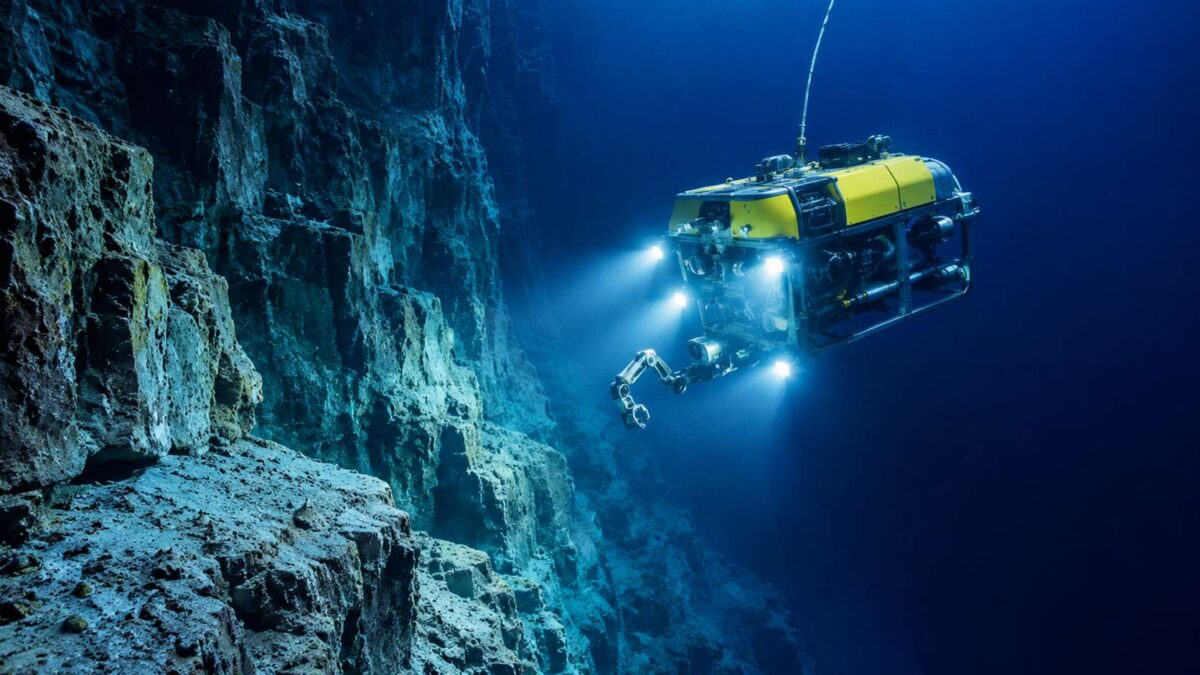
Mariana Trench volcanic deposits, Digimart Global (Mariana Trench, Pacific Ocean): More than 6,000 meters below the surface of the Pacific Ocean, a remotely operated underwater robot has found traces of explosive volcanic eruptions in one of the most extreme environments on Earth. According to a study co-authored by Robert Stern and published in Frontiers in Earth Science, the discovery was made in the Mariana Trench, the deepest known region of the world’s oceans.
The Mariana Trench sits where the Pacific Plate dives beneath the Philippine Sea Plate in a subduction zone. In late 2024, an international team used the Jason/Medea remotely operated vehicle to explore the trench walls and collect rock samples.
The robot could not reach the trench floor because of the extreme pressure, so researchers pushed it to its 6,500-meter limit to survey the northern wall over a segment roughly 300 kilometers long.
Unexpected volcanic rocks at depth
At depths near 6,000 meters, the researchers found volcanic rocks rather than the non-volcanic material they had anticipated. Closer examination showed the material to be pyroclastic deposits, which are produced by explosive eruptions.
The deposits are the deepest of their kind ever found, according to the study.
Such activity is unusual in this part of the subduction system. The overlying plate is typically cold, and the mantle beneath it is generally too cool to melt and produce magma, even with fluids released from the descending plate.
Observing volcanic activity there would normally require special tectonic conditions, such as strong extension that lets hotter mantle material rise.
Explosive eruptions are usually linked to the rapid decompression and expansion of gases dissolved in magma. At more than 600 bars of pressure at this depth, that expansion should be limited in theory, which makes the findings puzzling.
The researchers suggest the deposits may be linked to an eruption style controlled by supercritical fluids. Stern said the team is still studying the phenomenon and trying to understand it.
Questions for future research
The study’s authors say the location of this magmatic activity, close to the axis of the trench, challenges models developed so far. The data collected so far help constrain the dynamics of this segment of the Mariana Trench, though further work is needed to explain how the eruptions occurred under such pressure.