Joburg mine tailings radiation, Digimart Global: Environmental experts say a million or more people in Gauteng’s former goldfields face potentially serious health and environmental risks from radioactive mine tailings and poorly managed mining waste. Eco-activists and mining experts argue that abandoned, ownerless and inadequately rehabilitated mines are exposing residents to potentially hazardous substances, including uranium and other heavy metals.
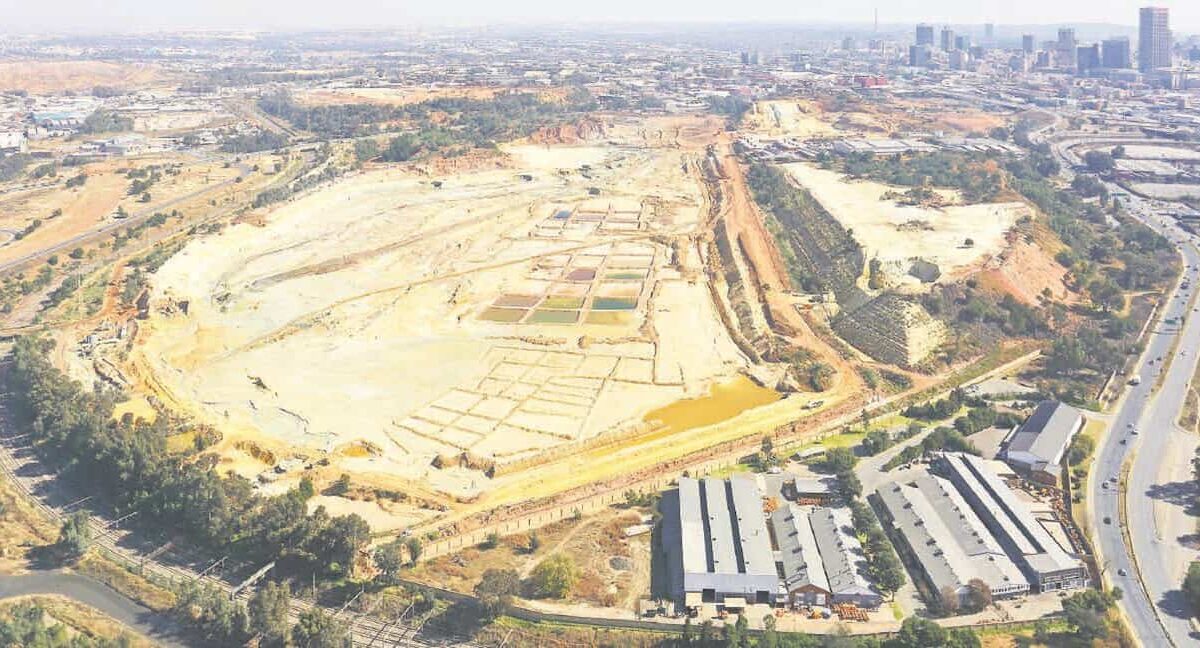
Mariette Liefferink, an expert at the Federation for a Sustainable Environment (FSE), told eNCA that most mine residue deposits in the region are radioactive because gold ore in the Witwatersrand occurs alongside uranium. She said Johannesburg’s mining belt has about 270 mine dumps covering an area of 400km2, along with tailings storage facilities, some of which are being reclaimed, which she estimated contain about 600 000 tons of uranium.
According to Liefferink, radioactive material has historically migrated from mine dumps into surrounding wetlands, and some mine tailings have been used as construction material. She said investigations by the Council for Geoscience identified elevated radioactivity in large parts of Johannesburg’s CBD, with wetlands also affected, and that many radioactive hotspots have no access control, fences or warning signs.
Liefferink said uranium poses radiological and chemical health risks, with exposure potentially contributing to kidney damage and other complications. A major concern is radon, a gas released continuously from exposed dumps as uranium-238 and radium-226 decay.
Radon can seep through foundation cracks and accumulate in homes and schools, particularly during cold Highveld winters when windows stay closed. The Cancer Association of South Africa says inhaling radon gas products damages lung tissue and sharply increases cancer risk, especially for smokers.
Estimates cited in the report suggest about 1.6 million people in Johannesburg and the West Rand live directly next to, or on top of, these radioactive dumps, even though mining guidelines recommend a 500-metre buffer zone around tailings. Liefferink criticised regulatory gaps, arguing that the National Nuclear Regulator (NNR) has interpreted its mandate narrowly and mainly deals with radioactive waste on licensed sites, leaving contamination outside them inadequately regulated.
She said the department of environmental affairs also does not regulate radioactive waste, and that the NNR faces capacity constraints in enforcing rehabilitation requirements.
Mining expert David van Wyk said communities near abandoned and poorly managed mines along the Main Reef Road corridor, from Springs in the east to Westonaria in the west, face serious health and environmental risks. He said the waste contains substances including uranium, lead, arsenic, silica, cadmium, strontium, copper and iron, most of which he described as carcinogenic, and he called for mining companies to be held accountable for failing to close and rehabilitate sites properly.
Mazi Choshane, an attorney at the Centre for Environmental Rights, said the department of mineral and petroleum resources (DMPR) needs to strengthen oversight and enforcement of rehabilitation obligations. She warned that transfers of mining rights should not allow companies to escape accountability, noting that larger companies often sell rights to smaller operators after extracting the most economically viable minerals, and that these smaller firms may lack the financial and technical capacity to rehabilitate decades of accumulated damage.
The DMPR had not responded to questions by the time of publication.