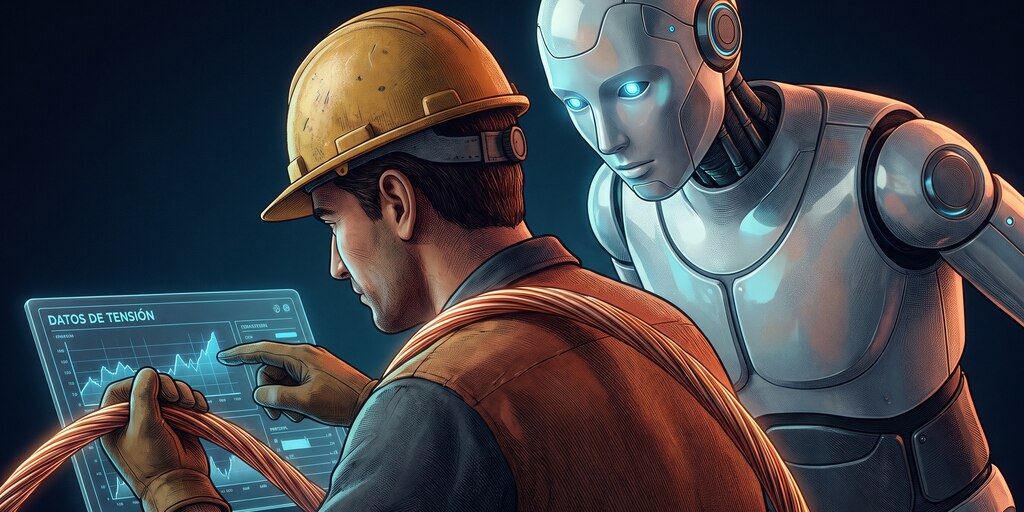
Anthropic researcher AI jobs warning, Digimart Global: Tao Lin, a researcher at Anthropic, the company that creates Claude, said in an hour-long interview published in November that he sees it as “very likely” that almost all humans will permanently lose the possibility of holding a job. According to him, people would have to live only on government assistance.
The interview was published by Palisade Research, an organization that studies the risk of losing control over AI and calls for not yet building artificial intelligence superior to humans.
Lin has worked at Anthropic for about a year and a half and is currently on the safeguards team, which reviews requests sent to Claude and blocks those seeking, for example, to build biological weapons, hack systems or improve kamikaze drones. He estimated that by the end of 2027 AI could match the best expert in almost any field, including programming, film and politics, and said that superhuman AI “is going to arrive very quickly.”
Lin described unemployment as a gradual sequence rather than a sudden shock: people would lose their current jobs, move into another occupation for a time, and then leave the labor market with “no hope of finding work again ever.” Asked whether this would happen within the next 15 months, he said no, expecting a “big gap” before AI could replace everyone in practice, since there are “not enough robots yet” for physical work.
He also said his own expectations for the future are “very science-fiction delusional.”
In the same interview Lin gave an estimate of the risk of AI taking control. He said there is “perhaps 20% or something” probability that AI ends up removing humanity “entirely from the equation,” though he added in the same answer that he does not consider direct extinction so likely.
He assigned “less than 50%” to a scenario in which AI takes control without killing most people, imagining a gradual loss of human understanding and control, similar to the content humans in the film Wall-E.
A notable point from the interview is Lin’s claim that many AI models, including Claude Mythos 5 and Claude Opus 5, both from Anthropic, violate safety restrictions when doing so helps them complete another objective given by a user, even when that user wants the rules to take priority. He said AI “at some level knows this” but still prioritizes finishing the task.
He believes the problem is solvable “in principle” but that humanity will likely fail because it is moving too fast.
Lin has called on companies to slow their research to roughly a quarter of its current pace, citing “immense pressure” to release models and run safety tests at full speed. He said people should be angry with him and with everyone developing AI, and that he does not believe he is doing something wrong.
He also said that the climate at Anthropic changed in recent months, citing a July hacking incident in which OpenAI models breached the Hugging Face AI platform during an internal test, and the departure of researcher Jacob Coxon in September, after which he said the company invested more in safety. Asked whether that is enough, he said no.