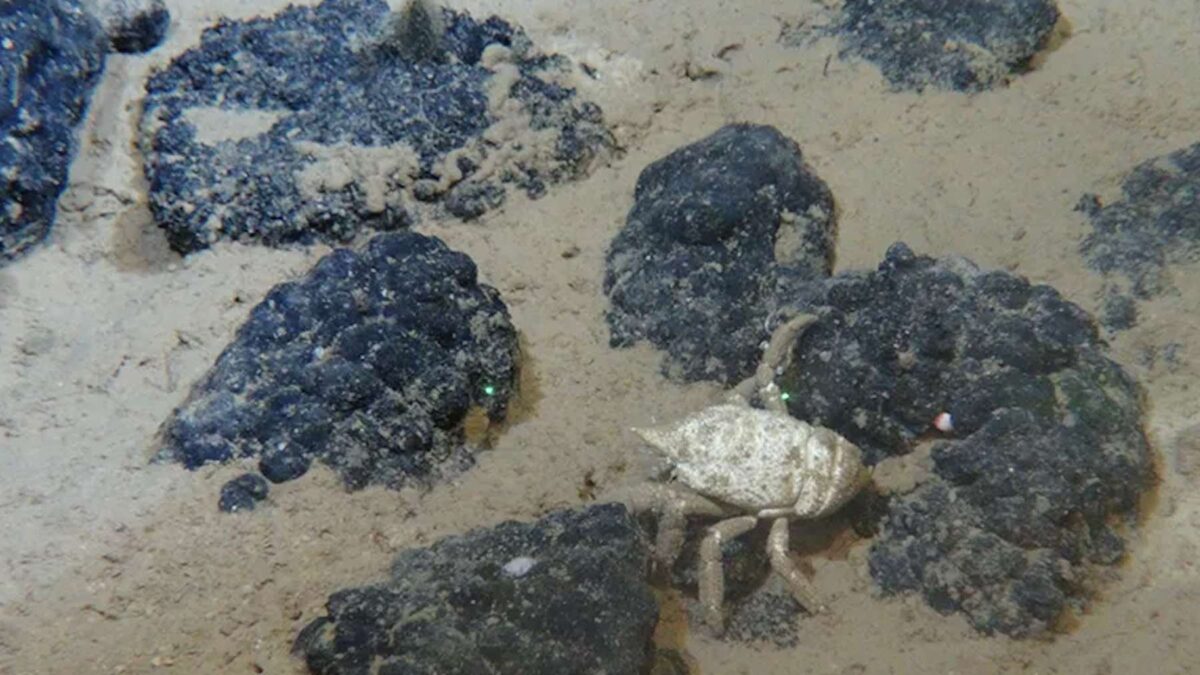
Deep-sea polymetallic nodules, Digimart Global (Clarion-Clipperton zone, Pacific Ocean): Scientists from the Center for Marine Environmental Sciences at the University of Bremen in Germany retrieved 244 dark, dented, metal-rich rocks from a depth of between 4,000 and 6,000 meters in the Pacific during a 2019 sampling mission. The nodules, often compared to potatoes, were collected in the Clarion-Clipperton zone.
When the researchers examined the interior of the nodules, they found a hidden ecosystem. The team counted 4,139 animals in total, an average of about 17 per nodule, with one nodule containing 245 individuals.
The animals included roundworms, crustaceans, a shelled amoeba and tardigrades, according to the study published in Scientific Reports.
Living spaces inside the rocks
The study reports that the nodules’ complex internal structures create three-dimensional spaces that allow animals to live in protected areas within the rock itself. Rather than serving only as surfaces to which marine organisms attach, the nodules appear to function as small habitats.
Communities found in nodules collected about 1,000 kilometers apart were more similar to one another than to communities living in the surrounding sediment, according to the research. The authors also note that these nodules grow by only about 1 millimeter per million years, so the ecosystems they support may take millions of years to develop.
Implications for seabed mining
The nodules are rich in nickel, cobalt, copper, iron and manganese, metals that are sought after for industrial use. The Clarion-Clipperton zone is expected to be opened to mining, and the report warns that if the International Seabed Authority permits large-scale extraction of the nodules, these ecosystems could be destroyed irreversibly before they are fully understood.
The findings leave open the question of whether the habitat should be exploited while scientists still know little about it. The source material does not indicate a decision on mining permits.