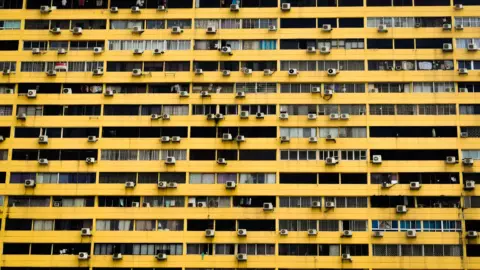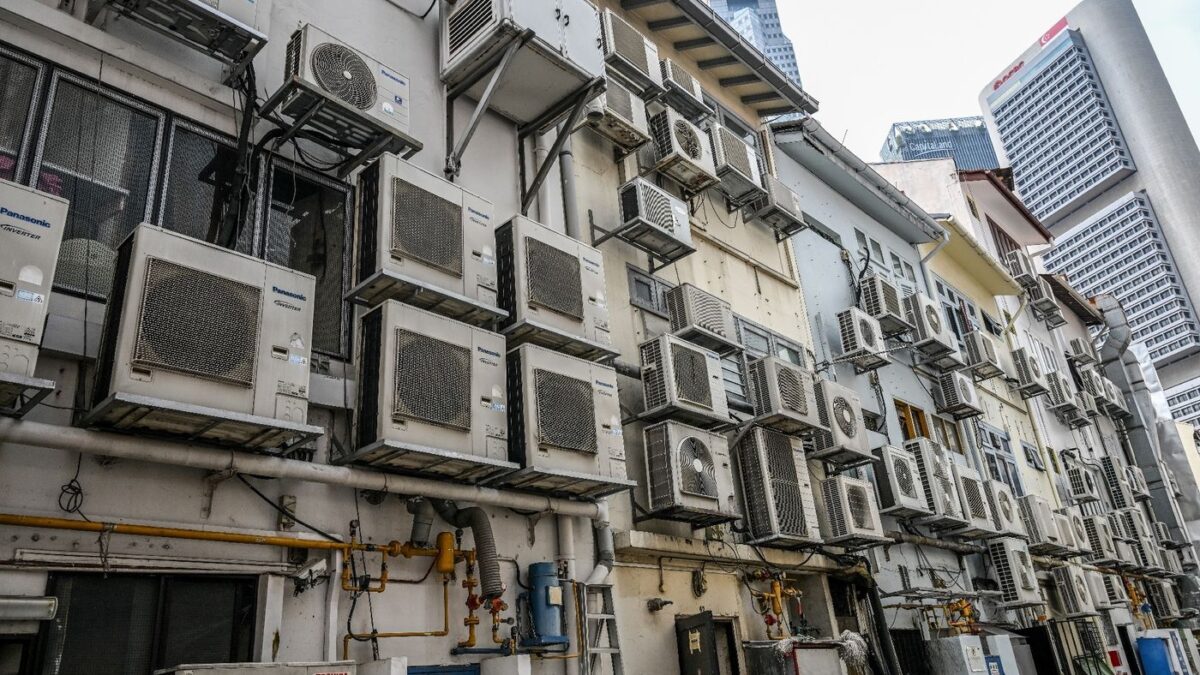
Singapore air conditioning alternatives, USA News (Singapore): Long nicknamed the “nation of air conditioning,” Singapore is experimenting with alternative cooling solutions to curb its heavy reliance on air conditioning, a major energy consumer. The city-state boasts the highest rate of air conditioners per capita in Southeast Asia, with 99% of private homes equipped. The local building sector accounts for one-fifth of the country’s emissions, and cooling alone absorbs 40 to 60% of a building’s energy, according to several studies.
At Orchard Road, fresh air jets pour out onto the street as pedestrians pass by. However, compressors expel hot air, and the electricity used fuels climate change if it originates from fossil fuels.
Silent Offices and Induction Beams
To reduce this energy bill, certain buildings in Singapore are considering alternative solutions, notably “induction chilled beams,” which are perforated panels equipped with coils fixed to the ceiling. Water cooled to 9°C circulates through them, while air jets draw in the warm air of the room to cool it before redistributing it. This system maintains the offices of Paya Lebar Green at 24°C.
An AFP team observed noticeably fresher air and a complete absence of the humming sound typical of traditional air conditioners. When Renuga Shekar, a 30-year-old human resources specialist, moved in last November, she and her colleagues initially thought the exposed pipes and panels on the ceiling gave a “warehouse look.” She told AFP that they did not pay much attention to it and nobody made any comments.
It was only months later, after noticing how quiet the office was and hearing technicians mention “induction chilled beams” during maintenance, that they realized the space was equipped with them. She added that they did not even notice how different the system was because it operated discreetly and provided an ideal temperature for everyone.
According to DP Architects, the designers of Paya Lebar Green, this system reduced energy consumption by more than 30% compared to conventional air conditioning. The Maritime and Port Authority of Singapore, located at the Tuas Port in the west of the city, uses a similar system.
Shift in Mentality
Another alternative is passive radiative cooling, where water cooled between 14°C and 18°C circulates through panels to absorb ambient heat. A 2004 (2024 in source) government study identified alternative cooling technologies as a key strategy, estimating that “they could save the city up to 48% in energy.” By mid-2026, at least 33 public buildings and 14 public (private) buildings had adopted these technologies, according to Singapore’s building authorities, as the city-state targets carbon neutrality by 2050.
These figures remain relatively modest compared to the widespread use of traditional air conditioning. Proponents acknowledge that installation costs are higher than conventional systems, but argue this gap is offset long-term by lower operating costs from significant energy savings.
The most popular alternative remains hybrid cooling, which involves setting the air conditioning to a warmer temperature between 25.5°C and 27°C and pairing it with fans. Chua Zi Jun, a director at DP Architects, noted that people are accustomed to air-conditioned offices, and accepting 26 degrees suddenly has not yet reached a general tipping point of acceptance.
Traditional systems rely on vapor compression, using refrigerants to transfer heat. Alternative cooling technologies use the same basic principle but consume less energy or shorten operating durations by leveraging human adaptability to slightly warmer temperatures. Wan Man Pun, a cooling technology expert at Nanyang Technological University, stated that these technologies are a step in the right direction and should eventually incorporate more sophisticated regulation systems, such as predictive systems that adjust temperatures proactively. However, he emphasized that they still lack a cooling alternative with a coefficient of performance or efficiency superior to vapor compression.