

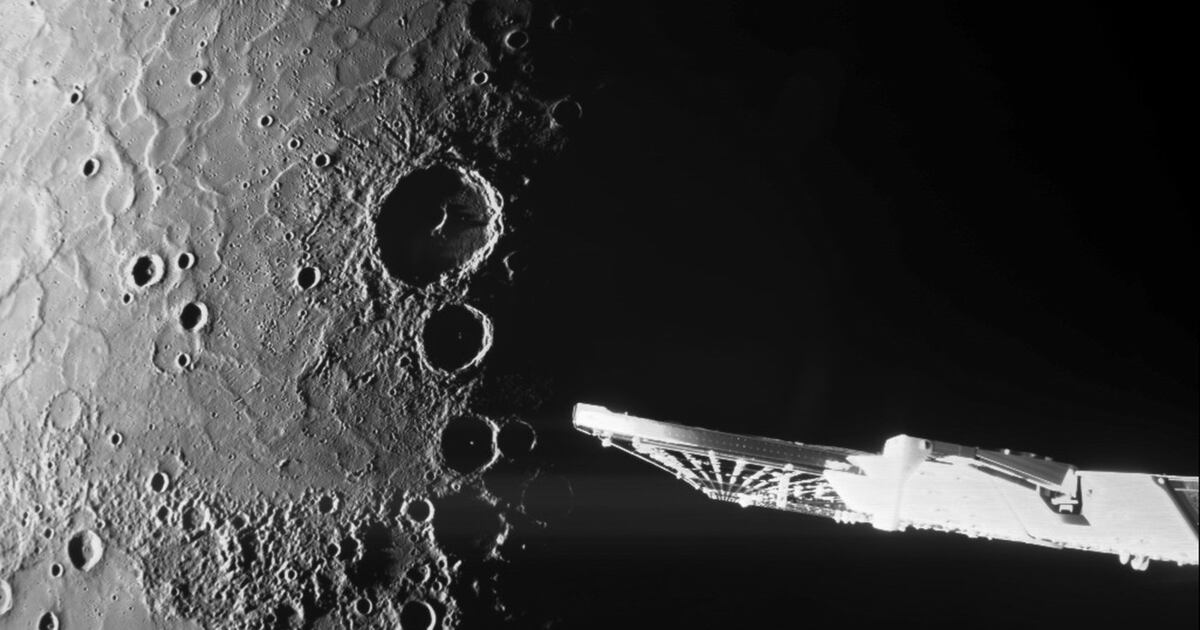
BepiColombo Mercury orbit, Digimart Global: A pair of spacecraft slipped into orbit around Mercury on Saturday after an eight-year cruise through the inner solar system. The linked robotic explorers, one European and one Japanese, are part of the US$2 billion (1.7 billion euros) mission known collectively as BepiColombo.
The European Space Agency announced the arrival via social media. A series of thruster firings slowed the spacecraft enough for Mercury’s weak gravity to capture them.
Flight controllers in Germany, about 94 million miles (152 million kilometres) away, needed several anxious hours before they could confirm the spacecraft had achieved orbit.
A mission named for a mathematician
BepiColombo is only the third spacecraft to visit Mercury, the sun’s closest planet and barely bigger than the Moon, and the first in more than a decade. NASA’s Mariner 10 flew past Mercury three times in the mid-1970s, and NASA’s Messenger entered orbit in 2011 before crashing into the planet in 2015. The mission is named for the late Italian mathematician Giuseppe “Bepi” Colombo, who was part of the team.
A long, roundabout route
Launched in 2018, BepiColombo took a slower, more roundabout route, flying once past Earth, twice past Venus and six times past Mercury for gravity-guiding assists. The conjoined spacecraft shed their mother ship in September for the final leg of the journey.
Separating to study Mercury
The two spacecraft will separate from one another next month to map and study the planet from different altitudes. Once orbiting separately, the European Space Agency’s satellite and the Japan Aerospace Exploration Agency’s smaller craft will study Mercury’s dense interior and exterior magnetic field, along with impact craters, volcanic plains, and mountain ridges and peaks rising as high as 3 miles (4.5 kilometres).
Lead project scientist Geraint Jones said the team looks forward to new data arriving in the spring, which will allow comparison of “unprecedented measurements taken by two spacecraft at the planet at the same time.” Mercury’s surface temperatures can exceed 800 degrees Fahrenheit (427 degrees Celsius), adding strain to electronic and engineering systems, and officials hope to keep the mission running for at least one Earth year, equal to about four Mercury years.
Despite its relative proximity to Earth, Mercury is one of the least explored planets in the solar system. Only Uranus and Neptune have had fewer visitors, with a lone Voyager 2 flyby in the 1980s.