

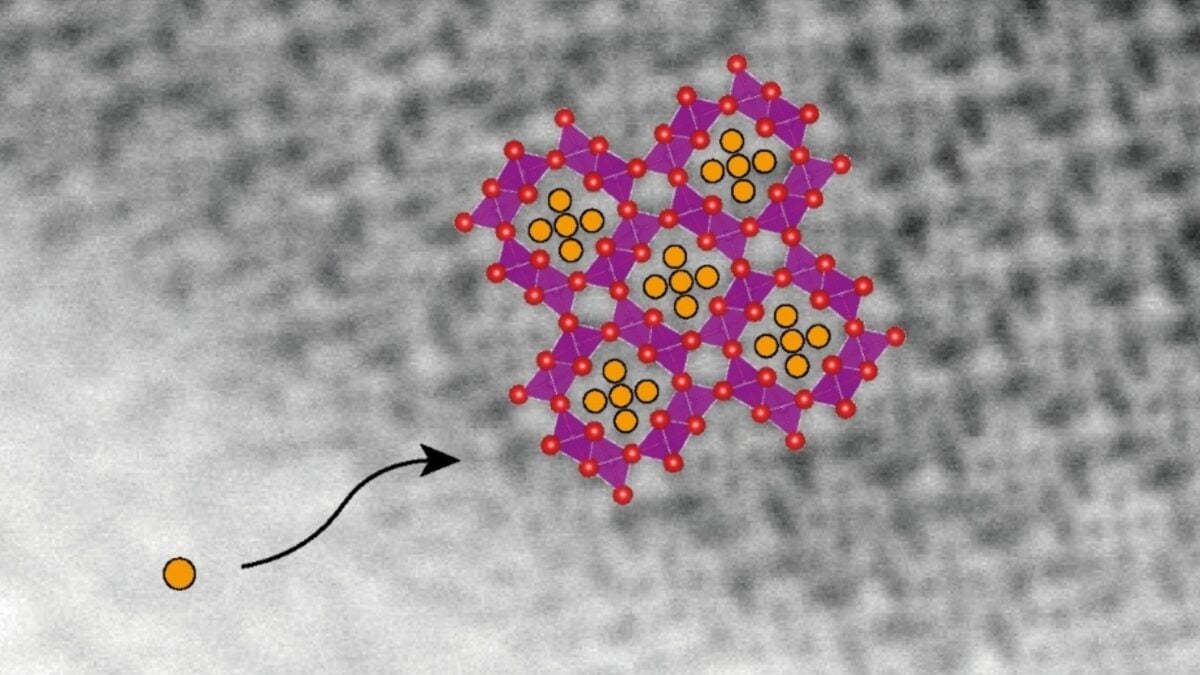
Next-generation battery ion insertion hollandite manganese dioxide, Digimart Global: Ions move into and out of the electrode materials of rechargeable batteries as they charge and discharge. Researchers are now asking where those ions settle inside the crystal structure and whether that location affects performance.
The question matters most for next-generation batteries that use abundant elements such as sodium, magnesium and calcium instead of lithium.
According to a publisher report on Mirage News, a research team at Tohoku University found that these ions behave very differently even when inserted into the same electrode material. The team studied hollandite-type manganese dioxide, a material containing tiny one-dimensional tunnels that provide pathways for ions.
The report says that enough space for ions does not guarantee that they can move easily or that the surrounding crystal structure will stay stable.
The researchers combined electron microscopy at the Tohoku Center of Excellence for Microscopy with X-ray absorption spectroscopy at NanoTerasu, a synchrotron radiation facility. According to the report, sodium ions spread relatively uniformly through the particles and sat near the tunnel centres.
Magnesium ions entered the particles but tended to accumulate near the surfaces, causing significant distortion of the surrounding crystal structure. Calcium ions remained mainly near the particle surfaces, with little evidence of insertion into the interior tunnels.
X-ray measurements indicated that magnesium insertion caused more pronounced changes in the electronic states of manganese near the particle surfaces, while sodium produced more uniform changes and calcium produced only minor changes. The report also states that repeated magnesium insertion and extraction damaged parts of the tunnel structure near the surfaces.
This local damage was associated with material loss and declining battery capacity, even though the overall crystal structure remained largely intact.
The publisher report says the findings were published in Chemistry of Materials on November 4, 2026, with Hongyi Li as lead author. The researchers suggest that better electrode design will require controlling where ions settle and how they affect neighbouring atoms, not just providing pathways for ions.
The work may help guide development of more durable, higher-capacity cathode materials, although the report does not describe any commercial product or timeline.