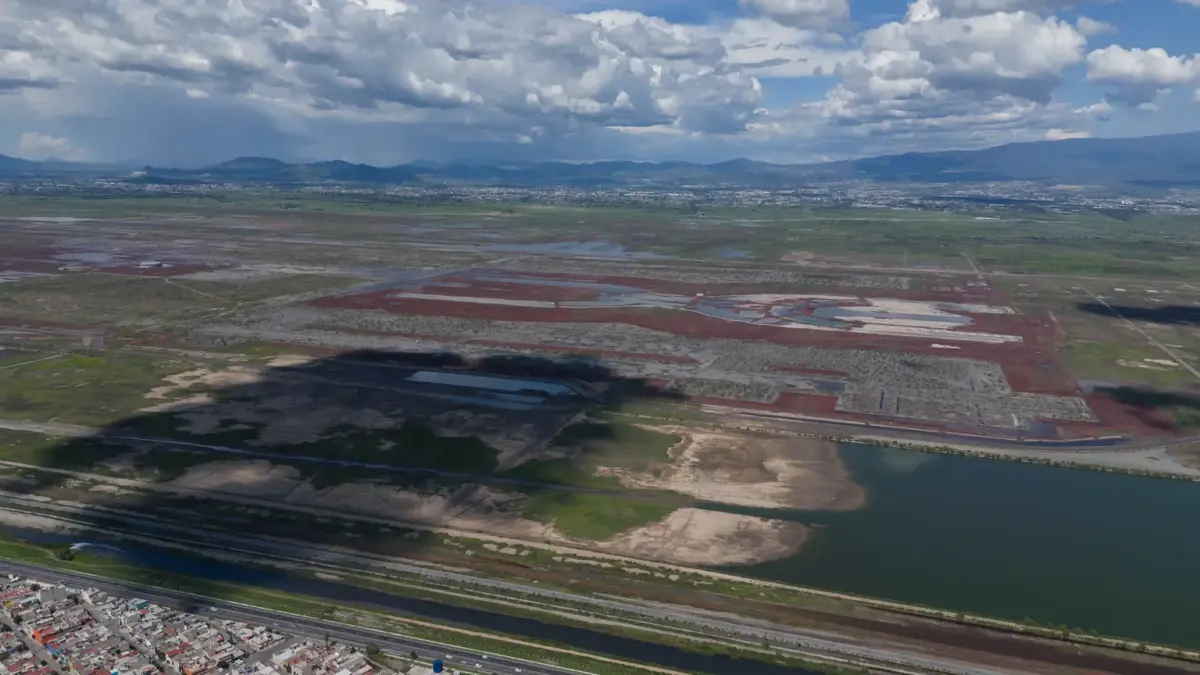
AIFA and NAIM, USA News: Mexico needs to review its airport policy with a long-term vision, leaving behind the political differences that have accompanied decisions in recent years. The fundamental question is whether the current system offers the capacity, connectivity, and efficiency that the country will need over the coming decades. The Felipe Ángeles International Airport (AIFA) is infrastructure that must be utilized. However, its existence does not eliminate the need to evaluate whether it is advisable to recover and update the project of the New International Airport of Mexico (NAIM) in Texcoco, taking advantage of existing works that are technically and economically recoverable. It is not about rebuilding the past, but rather reconsidering a strategic alternative for the future.
Airport Capacity: Two Projects of Different Scale
The AIFA features two 4,500-meter civil runways and a terminal with 28 contact positions. The NAIM was conceived as a high-capacity international airport, with three runways in its initial stage and a master plan contemplating up to 95 contact gates in its projected initial development. Although boarding gates and parking positions are not equivalent, the figures reflect the scale of the Texcoco project and its orientation toward greater international connection capacity. The comparison must consider not only runways and terminals, but also taxiways, airspace, flight procedures, and the ability to handle future passenger and cargo growth. The question is inevitable: should Mexico definitively discard that infrastructure or evaluate how much it would cost to recover it and what benefits it could offer?
Accessibility: Time Also Costs
The AIFA is located north of Mexico City and requires travel times that vary considerably depending on the passenger’s origin, traffic, and route used. Texcoco, meanwhile, was designed to offer an alternative closer to certain areas of the capital and its main economic centers. However, the real advantage must be measured through effective travel times, toll costs, and public transport availability, not solely by geographic distance. An updated mobility study would allow for an objective comparison of both schemes and determine how much time and money it represents for users to reach each airport. Accessibility is part of airport competitiveness and must form part of any serious evaluation.
The Financial Cost of Canceling the NAIM
The cancellation of the project generated obligations related to contracts, indemnifications, and financing. Part of the financial commitments was met through mechanisms linked to airport revenues, including airport use fees at the Mexico City International Airport. It is important to distinguish between the cost of executed works, indemnifications, debt service, and future expenses. Only a comprehensive evaluation will reveal the accumulated cost and remaining obligations. Resuming the NAIM would not automatically eliminate those commitments, but studying the recovery of existing infrastructure alongside a viable investment and financing model could offer alternatives to utilize assets and improve long-term profitability. The federal administration should compare, with verifiable figures, the cost of continuing the current system versus recovering and modernizing Texcoco.
Private Investment Could Participate Again
An airport project of this magnitude requires capital, technical experience, and operational capacity. Therefore, it would be convenient to explore whether investors, contractors, and operators who participated in the original project, as well as new national and international participants, would have an interest in evaluating a new stage. It cannot be taken for granted that they would return or accept previous conditions; their participation would depend on economic viability, legal certainty, and a reasonable distribution of risks. A competitive investment structure, including the possibility of public-private partnerships when convenient, could reduce pressure on public resources and leverage specialized operators. Before discarding that possibility, it is worth knowing what alternatives the market would be willing to offer.
Air Routes: Efficiency That Can Translate Into Savings
The location of airports, arrival and departure procedures, and airspace design directly influence fuel consumption, delays, and airline operating costs. Comprehensive planning that optimizes routes and reduces unnecessary waits could generate important savings, improve punctuality, and decrease polluting emissions. Recovering the concept of Texcoco, if studies justify it, would have to be accompanied by a revision of the airspace in the Valley of Mexico and SENEAM procedures in coordination with airlines and aeronautical authorities. It would not be responsible to affirm a specific savings figure without technical simulations, but it is responsible to demand the quantification of potential reductions in flight times, unnecessary routes, and fuel consumption. Multiplied by thousands of operations, these efficiencies could represent relevant economic benefits for the industry and the country.
A State Decision
The AIFA is in operation and must be utilized. At the same time, reconsidering Texcoco does not mean ordering its immediate reconstruction, but rather opening an independent evaluation that answers fundamental questions regarding recoverable works, completion costs, comparative capacity, long-term financial costs, viable private participation, and potential reductions in flight times and fuel consumption. Aviation is strategic infrastructure for tourism, commerce, investment, and national competitiveness. Its decisions produce consequences for decades and must be based on technical and financial studies rather than immovable political positions. If an independent evaluation demonstrates that recovering and modernizing Texcoco offers greater economic and social benefits, the government should consider that alternative. If results favor the current scheme, those should also be made public. Mexico does not need to defend past decisions; it needs to make the best decisions for its future.