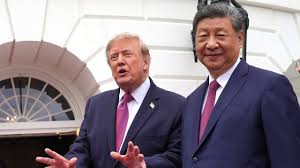
China APEC summit Shenzhen global leadership, Digi Mart USA News (Shenzhen, China): As China welcomes world leaders to the Asia-Pacific Economic Cooperation (APEC) forum this week in Shenzhen, CBC News reports that the country presents a very different picture than when it last hosted the event in 2014. Amid global conflicts, tariff disputes and economic instability, Beijing is using the summit to cast itself as a reliable global power capable of uniting leaders and brokering international economic cooperation.
CBC News reports that the summit’s most notable proposal is a tripartite meeting hosted by Chinese President Xi Jinping with U.S. President Donald Trump and Russian President Vladimir Putin, which it describes as the three largest nuclear powers.
The meeting is proposed rather than confirmed. Some observers compare the gathering to the 1945 Yalta Conference, though analysts quoted by CBC News differ on how much China can realistically achieve.
According to CBC News, Trump arrives in a weakened domestic position following a midterm election defeat, with voter anxiety over the cost of living and the U.S.-Israel war with Iran taking centre stage. The Iran conflict is expected to come up because both China and Russia maintain strategic partnerships with Iran.
The war in Ukraine is also a likely agenda item, with neither Ukraine nor other European states seated at the table.
Henry Huiyao Wang, founder and president of the Center for China and Globalization, told CBC News that both Washington and Moscow are growing fatigued, leaving an opening for China to step in as a mediator. CBC News also reports that Trump suggested a meeting with North Korean leader Kim Jong-un was possible, saying it was up to Xi, and that he plans to raise nuclear disarmament, a subject China appears wary of.
Economic and trade talks will run alongside the high-profile diplomacy. CBC News reports that Nvidia CEO Jensen Huang resigned following revelations of an affair with an alleged Chinese spy, which could make it harder for China to access advanced chips, and that AI competition between Washington and Beijing could feature on the agenda.
Some deals have also been announced, including loosened restrictions on Canadian pork and seafood imports into China in exchange for Canadian market access for Chinese steel and aluminum.
Canadian Prime Minister Mark Carney said Canada could turn to Chinese automakers if trade talks with the U.S. do not preserve the North American auto industry, following Stellantis’s announced sale of its Brampton, Ont., assembly plant to Roshel, according to CBC News.
Ning Leng of Georgetown University told CBC News that Beijing will try to reassure Latin American and Southeast Asian countries through promises of industrial upgrades and AI and digital infrastructure development.