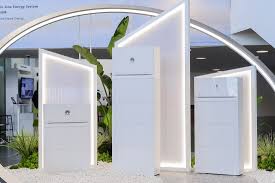
Huawei Luterra S2 residential energy storage system, Digi Mart USA News: Huawei has launched the Luterra S2, an all-in-one residential energy storage system that combines a hybrid inverter, lithium iron phosphate (LFP) batteries and AI-based energy management, according to a report published by pv magazine Australia.
The system is offered with single-phase hybrid inverters rated from 3 kW to 10 kW and three-phase units from 5 kW to 20 kW. Up to three 20 kW inverters can be connected in parallel, providing a maximum combined output of 60 kW.
The LFP battery modules have nominal capacities of 5.02 kWh and 7.03 kWh, with usable capacities of 4.9 kWh and 6.9 kWh respectively. The smaller module supports rated charging and discharging powers of 2.5 kW and 3 kW, compared with 3.5 kW and 4 kW for the larger version, with peak discharge power over 10 seconds reaching 5 kW and 7 kW.
Both modules measure 590 mm × 255 mm × 290 mm and weigh 46 kg and 57 kg.
The modular design supports up to 48 battery packs across interconnected systems, for a maximum nominal storage capacity of 336 kWh when using the 7.03 kWh modules. Huawei said the batteries feature integrated energy optimizers and are designed for a service life exceeding 15 years, and it claims lifetime usable energy throughput of up to 5 MWh per kWh of battery capacity.
According to Huawei’s preliminary specifications, single-phase models reach a maximum efficiency of 98.6%, compared with 99% for three-phase units. The inverters use silicon carbide power electronics and active neutral-point-clamped topology, with maximum PV input voltages of 600 V and 1,100 V respectively, up to three maximum power point trackers and up to 40 kWp of PV input power on three-phase models.
For backup use, the company states a switchover time of less than 10 milliseconds and continuous off-grid loads of up to 20 kW. The 20 kW three-phase inverter can deliver peak backup output of up to 40 kW for 10 seconds, based on the same preliminary specifications.
The system is passively cooled, with claimed operating noise below 29 dB, an operating range from –25 °C to 60 °C and an IP66-rated enclosure.
Huawei’s AI Energy Management 2.0 platform uses weather forecasts, electricity tariffs, household consumption data and battery status to optimize energy flows between solar installations, storage, electric vehicle chargers and heat pumps, and it supports participation in virtual power plants. Huawei said the system has undergone TÜV Rheinland safety testing and reported UL 9540A validation and compliance with IEC 63027 arc-fault requirements.
The company has not disclosed pricing or market availability.