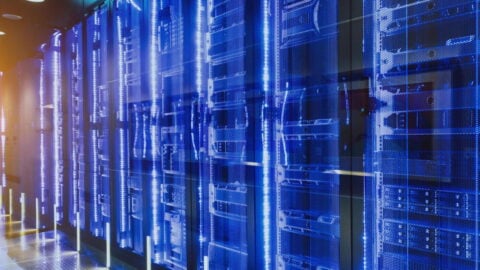
US data centers electricity use and emissions, Digi Mart USA News: According to a recently published account by an international team of researchers, America’s largest data centers used as much electricity as the state of Michigan between 2024 and 2025. The team, led by Gianluca Guidi, a biostatistician at Harvard University, reported that much of that power came from burning natural gas and coal.
The researchers used satellite imagery to verify the locations of 403 hyperscale data centers and relied on power-plant records to estimate their emissions. They found that the facilities’ electricity use was between 68 and 99 terawatt-hours in the year ending April 2025, which the study says would have accounted for 1.8% of total US electricity consumption that year.
At the high end, the estimate is close to the annual energy use of states such as Michigan or Tennessee. The power generation behind that demand would have added 25.7 million metric tons of carbon dioxide to the atmosphere, more than Denmark’s entire emissions for the same period, according to the study.
Detailed figures for individual facilities are rarely public, so the team matched commercial facility records against building footprints and satellite imagery, then estimated power use using assumptions about each site’s capacity, including cooling and round-the-clock operation. Each data center was assigned emissions based on the power mix of its regional grid, using US Environmental Protection Agency records from 2023.
About 54% of the attributed electricity came from fossil fuels, with natural gas supplying around 38% and coal 15%. Virginia alone accounted for about a quarter of the electricity in the study, and Oregon, Ohio and Iowa brought the four-state total to more than half.
The study found that each kilowatt-hour was associated with about 314 grams of carbon dioxide, below the comparable US average of 348 grams, but nearly a quarter of the demand was located in grid regions with above-average carbon intensity.
The researchers note that the results are not directly comparable with an earlier study, which put hyperscale electricity use at around 23 terawatt-hours in 2018, because the studies used different facility inventories and methods. Separately, Lawrence Berkeley National Laboratory estimated that US data centers of all sizes consumed 176 terawatt-hours in 2023 and projected this could reach between 325 and 580 terawatt-hours in 2028.
The study also highlights health concerns beyond carbon emissions. A separate University of California, Riverside analysis, as described in the report, estimated that the health burden associated with data center air pollution in California roughly tripled from 2019 to 2023, while the sector’s electricity use in the state nearly doubled.
Study co-author Francesca Dominici, also a biostatistician at Harvard, said decisions about where data centers are built and how they are powered are critical environmental and public health decisions.
The report notes that the US had 1,156 data centers in operation in 2025 and that 1,860 were running or under construction as 2026 came to a close, meaning the study’s estimates may already be outdated. The research was published in the journal Nature Sustainability.