Kennedy family lawsuit against Trump arch near Arlington National Cemetery, Digi Mart USA News (Washington, D.C.): One of America’s most prominent political dynasties has joined the growing fight against President Trump’s proposed arch in Washington, D.C. Nine members of the Kennedy family filed suit in federal court on Tuesday to block the 250-foot structure, saying it would obstruct their relatives’ gravesites, including the John F.
Kennedy Eternal Flame, at nearby Arlington National Cemetery.
In a statement on behalf of the family, Rory Kennedy and Maxwell Kennedy said a towering arch would cast shadows across the graves of their father, mother, and uncles, as well as those of many who have served the country. They said it would also undermine safeguards established by elected representatives to protect the hallowed ground.
The plaintiffs include children of Sen. Robert F.
Kennedy and Ethel Kennedy and a son of Sen. Edward M.
Kennedy, all of whom are buried at Arlington. Health and Human Services Secretary Robert F.
Kennedy Jr. did not join his siblings in the lawsuit.
A White House spokesperson, Davis Ingle, told NPR in a statement: “It is unfortunate to see that some members of the Kennedy family have joined the litigation against the Arch as the project is intended to honor our heroes who rest in Arlington Cemetery.” He added that the administration would continue making the case for the monument and was confident it would be vindicated as the litigation proceeds.
The Kennedys’ motion, filed hours before Veterans’ Day, seeks to join an existing federal lawsuit against the arch. That case combines a challenge brought earlier this year by Vietnam War veterans and an architectural historian with a suit filed late last month by the governments of D.C.
and Virginia. The Arlington County Board has also filed a lawsuit in Virginia.
The Trump administration moved the arch through the federal approval process over the past year, culminating in a final approval from the National Capital Planning Commission on Thursday. Officials had said construction could begin in Memorial Circle that same day.
Shortly after the late-night approval, District Court Judge Tanya Chutkan issued an order blocking construction for two weeks while she evaluates the broader legal challenges.
One of the main arguments against the arch is that its construction is unlawful without congressional approval, which the administration has not sought. The administration maintains that the arch is justified by a century-old authorization for two never-built columns at the same location.
Chutkan wrote last week that “merely to state this argument is to reveal its flaws.” The administration has also argued the case should be dismissed for lack of standing, but Chutkan has said D.C. and Virginia likely have standing given the financial and logistical harms they would suffer.
David Super, a Georgetown University law professor, told NPR that he believes the Kennedys’ involvement strengthens the plaintiffs’ standing. He said a judge would likely be uncomfortable dismissing concerns about family graves, and noted that the administration’s hints about tearing down the Kennedy Center could make the president appear hostile to his predecessor.
Several Kennedy family members have spoken out against Trump’s attempted takeover of the Kennedy Center, which is the subject of a separate lawsuit.
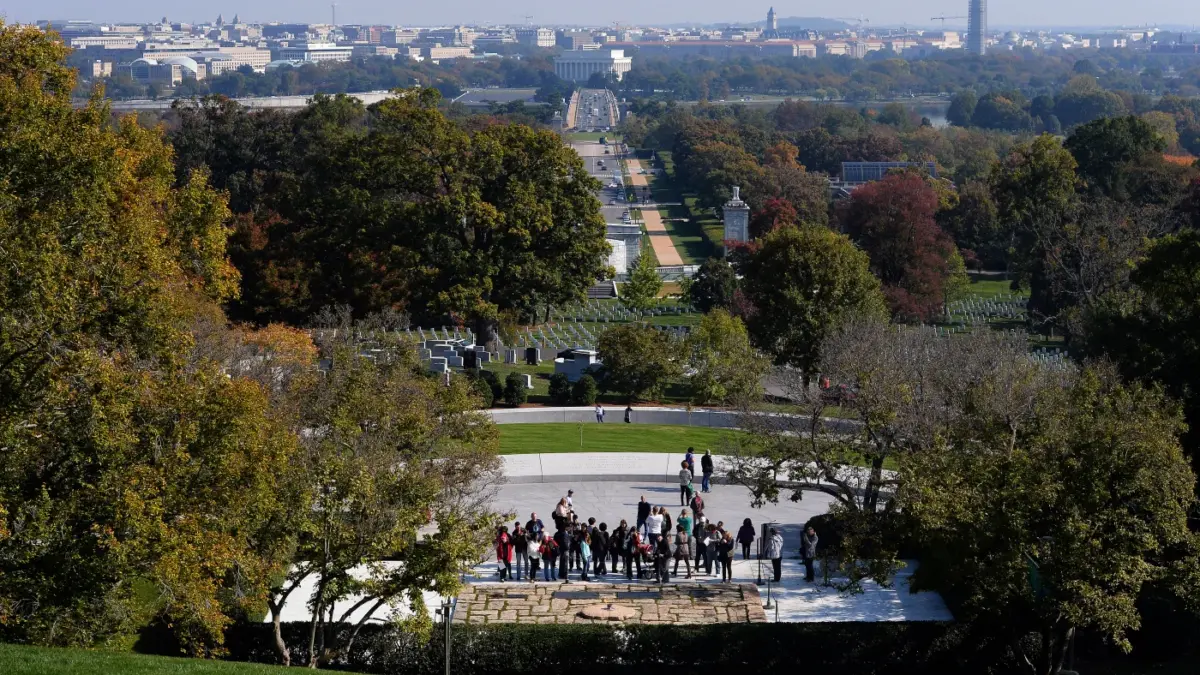
JFK’s gravesite, featuring an eternal flame, sits just below Arlington House, the former home of Confederate Gen. Robert E.
Lee. The arch would stand in a traffic circle on the bridge connecting Arlington House to D.C.’s National Mall.
The cemetery says JFK’s gravesite is one of its two most-visited locations, along with the Tomb of the Unknown Soldier. The Kennedys’ filing states that the family chose Arlington so the gravesite would be accessible to the public, and that the arch would block the views the family’s ancestors were assured would be preserved.
The filing also cites a forensic analysis by the Washington Post finding the arch would cast shadows over tens of thousands of graves, darkening JFK’s memorial on 50 days a year and briefly blocking the eternal flame on almost half of those days. The Kennedys said they often visit family graves in the morning, which is when the analysis found the shadows would be most pronounced.
The Trump administration has said the arch will be topped with its own eternal flame.
Arlington National Cemetery is the final resting place for more than 400,000 service members, veterans and their relatives. The White House has described the arch as a tribute to the nation’s military heritage that will enhance the visitor experience for veterans, families of the fallen, and all Americans.
Many veterans and family members have opposed the project through protests, tens of thousands of written comments, and nearly nine hours of public testimony at last Thursday’s planning commission meeting. Critics say the arch would disrespect those buried at Arlington and interfere with the 24 to 27 funeral services held there each weekday, as well as construction estimated to involve 20-hour days.
The administration has also recast the arch as a military structure in a public website and recent court filings, though the approved plan contains no national security details. In a 10-page declaration filed Tuesday, retired U.S.
Army Brig. Gen.
Steven Anderson argued that the arch would endanger national security, warning that storing ammunition in a tourist attraction would be a “tremendous risk” and that launching drones nearby, close to D.C.’s airport, “poses clear hazards” to civilians. Democrats have said they will use their forthcoming congressional majority to block the projects and investigate potential wrongdoing, though experts told NPR that given Trump’s veto power, the future of the arch will likely be decided by the Supreme Court.