2.6 Seconds: Death in the Outback docuseries on Kumanjayi Walker, Digi Mart USA News (Australia): Warning: Aboriginal and Torres Strait Islander readers are advised this article contains the name of an Indigenous person who has died.
Since 2019, Australia has grappled with the death of 19-year-old Warlpiri man Kumanjayi Walker. The teenager, who was armed with medical scissors, was shot three times and killed by Northern Territory police officer Zachary Rolfe.
Reckoning has come slowly. In 2022, a Darwin jury found Rolfe not guilty of murder.
A multi-year coronial inquiry later found the “hallmarks” of racism embedded within the Northern Territory police.
It was this tidal wave of uncomfortable information that led Blackfella Films producer and director Darren Dale, known for Redfern Now and Mabo, to make 2.6 Seconds: Death in the Outback. The four-part docuseries chronicles the before, during and after of one of the darkest moments in modern Australian history.
It is Dale’s directorial debut.
Dozens of interviewees present their reflections throughout the series, from Walker’s family members to police officials, legal professionals, journalists and community elders. For Dale, it was the only way to understand the full breadth of the tragedy.
“I think the binarism that exists in the world leads us to not hear a lot. I really didn’t ever want us to feel like we were shouting at people,” Dale told ABC News.
“The power of hearing is one of the reasons I think this project for me feels vital. If we can listen and not look away, we might just understand what happens in our own country.”
Dale travelled to Alice Springs and Yuendumu shortly after the coronial inquest began, on the encouragement of Andrew Boe, a barrister for the Walker families who also appears in the series. “I met some of the family, just to see and hear the things that were revealed at that inquest,” Dale said.
“I came straight back to Sydney, organised a meeting with SBS and said, ‘Look, this story demands to be told over four hours.'”
“This story isn’t just a story about Kumanjayi’s family. This is a story about police.
This is a story about people associated with the fallout. When one of these calamitous tragedies happens, the fallout for everyone is immense.”
The series first establishes the context of Yuendumu, a remote community about 300km north-west of Alice Springs, famed for its rich artistry and burdened by a long history of police violence. Through interviews with family members and professionals who cared for him, Walker is described as a funny, energetic young man with under-identified cognitive and developmental difficulties and a history of run-ins with the justice system.
Rolfe is described by colleagues as a proactive officer who developed a reputation for pursuing difficult arrests within a police culture that rewarded risk-taking. The days leading up to Walker’s death and the night of the shooting are presented through largely unseen police body cam footage.
In one post-shooting clip, an injured Walker is heard repeatedly wailing for his mother, Leanne Oldfield, who also features in the series. “I felt that it was really important that if you’re ever going to choose to look, you should look at this,” Dale said.
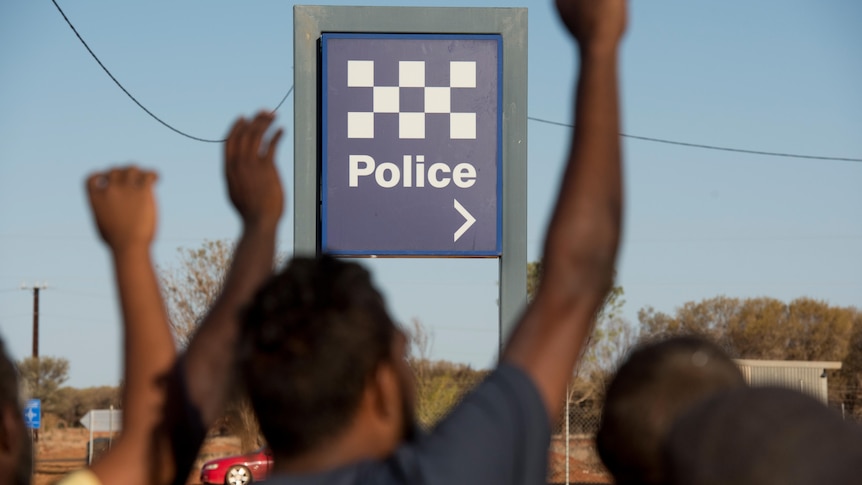
Later footage shows the frenzied aftermath of the shooting, in which a dying Walker was locked in a police station while his community was prevented from seeing him or learning about his condition. Only Derek Williams, a local Aboriginal police officer and Walker’s uncle, was allowed inside, but not for long enough to assess the situation.
Walker’s cousin Samara Nangala Fernandez-Brown and other residents began broadcasting live on social media as a growing crowd demanded information on his condition.
“I stood outside that police station and I realised that from where the family was sitting, to where Kumanjayi was dying was between 7 and 11 metres away,” Dale said.
The community gathered outside was not immediately informed of Walker’s passing, assuming an arriving police aircraft was taking him to Alice Springs for urgent medical attention. In reality, the aircraft was there to bring in police reinforcements and take Rolfe out.
He was airlifted to hospital for a shoulder wound. The community was not informed of Walker’s death until the early hours of the following morning.
“We wanted to truly understand what it was like to be outside and what it was like to be inside, what it was like to be black, what it was like to be white, what it was like to be a law enforcement officer, what it felt like to be like Derek Williams,” Dale said.
Among the 39 people interviewed, Dale said there was one more he would have liked to include: Zachary Rolfe himself. Rolfe declined an interview for the series, so Dale included his testimony from the coronial inquest and 2022 interviews he conducted with Seven’s Spotlight program.
“We needed to understand why he wanted to become a police officer. It was important that you knew that he went to Afghanistan to serve.
It was important to know just the number of jobs he had done as a young constable. These are uncomfortable truths we have to confront,” Dale said.
The second half of the series focuses on the three-year coronial inquest led by Northern Territory coroner Elisabeth Armitage. In 2022, when first questioned about his own alleged racism and that within the force, Rolfe declined to answer questions for fear it would expose him to penalty.
In 2023, Rolfe was dismissed from the Northern Territory police force in relation to a 2,500-word statement he posted online. When he returned to the inquest stand in 2024, Rolfe disclosed racist award ceremonies conducted by the Northern Territory police.
When senior police figures initially denied the accusations, Rolfe and his team supplied certificates proving the use of offensive images and language by NT police.
On July 7 last year, Armitage travelled to Yuendumu to deliver her findings: Kumanjayi’s death was avoidable, and Rolfe held racist attitudes in an organisation with the hallmarks of institutional racism. She also made 33 other recommendations.
The series asserts that as of March this year, only 11 had been explicitly and fully supported by the Northern Territory government and police.
“Who would have ever thought that Zachary Rolfe would be the whistleblower on racism in the NT police force?” Dale said. “That, I think, is one of the most extraordinary ironies.
I think it led the coroner to make the findings that she did. Will this bear the fruit that it needs?
As Andrew Boe says, let’s wait and see.”
As the release approaches, Dale says he feels “trepidatious” but acknowledges the privilege of presenting all sides of a bitterly sad situation. “I hope the series gives people an insight into how ill-equipped both men were and how as a country we’ve allowed that to happen,” Dale said.
Author Kate Wild, whose award-winning book The Red House is referenced in the show, notes that some people thought Kumanjayi had it coming and others thought Rolfe was a bad cop, but as Dale put it, “it’s never as simple as that.”
2.6 Seconds: Death in the Outback premieres on SBS and SBS On Demand from November 10.