AMOC ocean current collapse and Chicago weather, Digi Mart USA News (Chicago): In the 2004 film “The Day After Tomorrow,” global warming shuts down a major ocean current, triggering abrupt climate change and catastrophic impacts around the world. At the time the premise seemed far-fetched, but studies today suggest the same ocean current may be on the verge of collapsing.
If it does, it could change Chicago’s weather for 1,000 years.
Aidan Burdick, a PhD student in the Department of Earth and Environmental Science at Northwestern University, is part of a specialized research team. He works in a state-of-the-art laboratory, sifting through mud to look for fossilized flies.
In those ancient flies he sees a thermometer. “By far the biggest control on where these different species live is the air temperature,” Burdick explained.
Buried in the ancient climate record are clues about something much bigger.
“We were pretty sure we were underestimating the rate at which ice is melting,” said Dr. Erin Pettit, professor of geophysics and geology at Oregon State University.
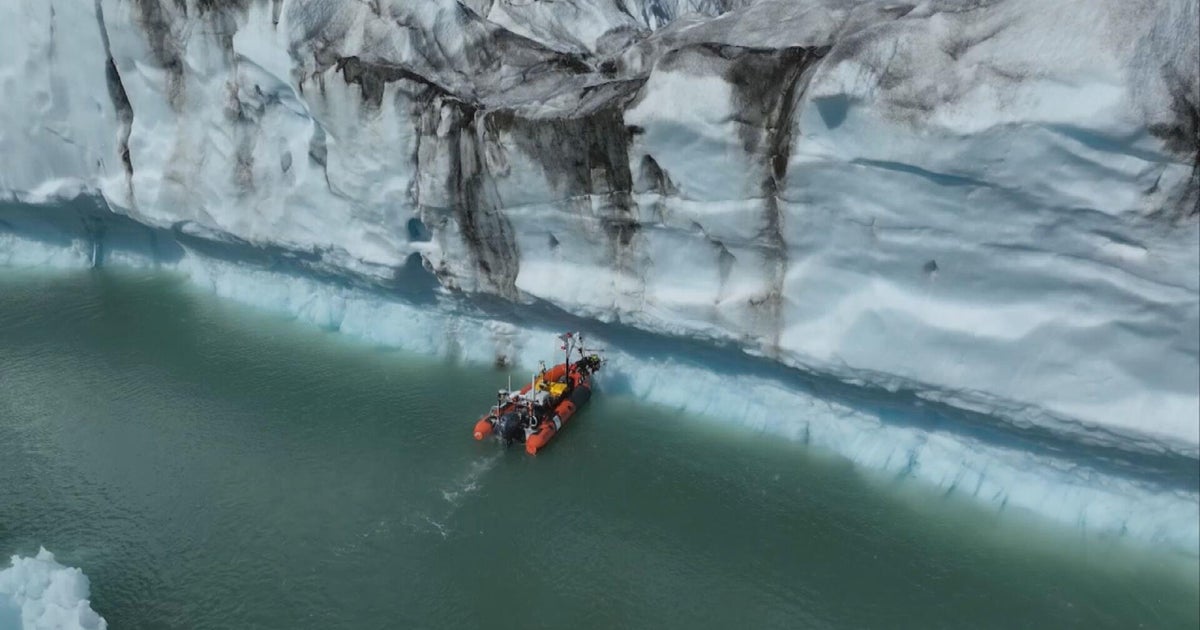
Pettit is part of a global team of researchers who spent six weeks in Greenland over the summer measuring glacier melt. Her project used underwater robots to drill small microphones onto the glacier face to listen.
“The process of melting glacier ice is really noisy, and so we can actually use the sounds to get an idea of how fast the ice is melting,” she explained. That will give scientists an idea of how likely it is that the Atlantic Meridional Overturning Circulation, or AMOC, will collapse.
The AMOC is a massive conveyor belt of heat in the ocean, flowing from Florida to Europe, driven by small differences in saltiness across the ocean. As fresh water melts from Greenland ice and pours into the North Atlantic, it disrupts a delicate balance and slows the current.
“For the first 30 years of my career I always considered the risk of crossing that AMOC tipping point a few percent. Now in the light of research in the last 5 years or so, I’ve actually had to revise that to 50/50,” said Dr.
Stefan Rahmstorf of the Potsdam Institute for Climate Impact Research. Rahmstorf is a world-renowned expert on the possibilities of an AMOC collapse and what it would mean for society.
“The impacts would be so massive, that it’s very hard to imagine that we could sensibly adapt,” he said.
His projections show a huge change in rainfall patterns worldwide, with some areas becoming much drier. That could change where people can grow food, leading to mass migration and even political instability.
He also said temperatures in northwest Europe and parts of North America would cool significantly, especially in winter, and sea levels would rise a foot and a half on the East Coast, leading to more frequent coastal flooding in major cities.
While Rahmstorf’s research shows that an eventual collapse is no longer a low-probability event, not all scientists agree on his timeline. The latest international climate change report finds “moderate confidence” that the current won’t abruptly collapse this century.
Rahmstorf said that misses the point. “Even if the full shutdown isn’t reached before 2100, the models show that it may well already be less than half as strong as it used to be,” he said.
That alone would lead to major global impacts. None of these projections fully account for ice melting from Greenland, which is speeding up a potential shutdown.
Rahmstorf and 43 other climate scientists signed an open letter to Nordic leaders, insisting the risk has been underestimated in previous research and urging leaders to prepare for, and try to prevent, what he called a catastrophe. “The only way to really reduce the risk of crossing that tipping point is to get out of fossil fuels as fast as we can,” Rahmstorf said.
That is no small task, as fossil fuels currently account for at least 65% of global energy consumption.
To understand how an AMOC collapse could affect Chicago weather, we turn to Burdick’s fossil flies. They were alive the last time this ocean current weakened, about 12,000 years ago.
By determining which fly species lived where back then, Burdick can tell that Chicago was colder at that time and that spruce trees, typical of colder northern climates, thrived here. Research shows that winter temperatures then were as much as 10 degrees colder than they are now, making Chicago’s winters as cold as Minnesota’s.
“We think the event lasted about a thousand years,” Burdick said.
While the collapse could lead to a millennium of colder Chicago winters, researchers caution that it would not cancel out global warming. While this part of the world could cool, other regions could warm even faster.
“When you’re looking at these climate changes in the past and thinking about their impacts on our modern society, it’s certainly concerning,” Burdick said. “Most climate scientists could not look you in the eye and say they didn’t have some level of nervousness or apprehension about what could happen in the future.”
Observations from the Greenland ice melt expedition are expected to be incorporated into climate models in the coming years, which will help scientists better predict the odds that this ocean current could shut down.