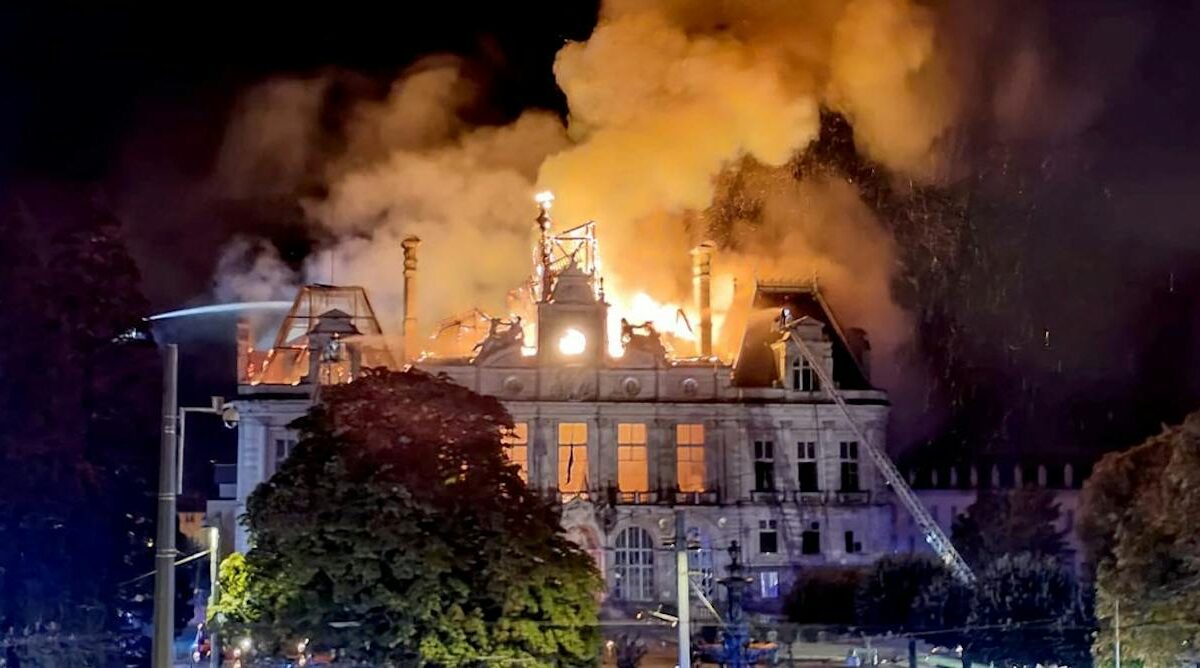
Limoges city hall fire political rhetoric, Digi Mart USA News (Limoges, France): Naming is never neutral. How the successive labels applied to the suspected perpetrators of the October 17, 2026 fire at Limoges city hall shaped the reading of events is the subject of this analysis, which draws on public statements and press articles published between October 17 and October 27, 2026.
Terms such as “hordes of savages,” “rear base” and “terrorist training camps” multiplied after the fire at the Limoges city hall, which occurred during social mobilizations. Several political officials blamed the far left and pointed to the Millevaches plateau, a rural area of the Limousin region, as a possible place of retreat or preparation for the violence.
Labels such as “rioters,” “troublemakers,” “assailants” and “far-left activists” are not interchangeable. The first three refer to acts or roles attributed to the participants, while the last introduces a political affiliation, real or assumed.
As research by Paul Siblot on naming has shown, naming is not only about identifying but also about adopting a point of view.
In a statement on October 17, Limoges mayor Guillaume Guérin referred to individuals “issued from or manipulated by the far left.” The following day, he told Le Monde: “The far left organized the logistics.” The attribution of responsibility for organizing the violence thus became explicit.
The press did not always adopt these characterizations. In its October 22 edition, La Montagne asked: “Was it really a coordinated operation?” and “The Millevaches plateau, rear base of the ‘far left’?” The paper also noted that “the activists as well as the assailants were not all identifiable.” The interrogative form marks an enunciative distance while still helping to circulate the hypotheses under discussion.
Beyond naming the participants, condemnation of the violence relied on heavily charged vocabulary. The prefect of Haute-Vienne described behavior belonging to “savagery” and “barbarism,” while Mayor Guérin spoke of “hordes of savages.”
The distinction matters: describing behavior as “savage” is not exactly the same as calling its perpetrators “savages.” The term “horde” suggests an undifferentiated and threatening human mass, while “savages” revives an older opposition between civilization and barbarism. Such terms appear not only in political discourse but have also been taken up in journalistic narration.
Le Figaro, for example, used the expressions “pack” and “violent horde.”
Other descriptions borrowed military vocabulary. A representative of the Alliance police union spoke of “paramilitary groups,” while a firefighter described scenes of “war” and “urban guerrilla warfare.”
To these images are added those of disease and its spread. In 2022, former deputy Jean-Baptiste Moreau described a “neofascist far left” that could “encyst,” “parasitize” and “metastasize” on the plateau “like a cancer,” according to remarks recalled by Le Figaro on October 21, 2026.
Cannes mayor David Lisnard, for his part, denounced those who let “this gangrene prosper.”
These images do not, however, carry the same meaning in every enunciative situation: warlike vocabulary may reflect the experience of a rescue worker or, in political discourse, suggest an organized threat.
This portrayal of the threat takes on a further dimension when Guillaume Guérin, in an interview with Die Zeit on October 22, as translated by Facto!, said that “the term ‘guerrilla’ is perhaps even insufficient” and spoke of “rather a civil war.” A guerrilla refers to a form of combat, whereas a civil war implies an internal armed conflict of a very different scale.
This reformulation changes the scale at which the event is interpreted.
On October 21, Le Figaro presented the Millevaches plateau as a “rear base” of the far left. Bartolomé Lenoir, deputy for the Creuse department, stated: “They hide out on the Millevaches plateau, and it is a rear base.
It is obvious.”
“Hide out” suggests concealment; “rear base” turns a rural area into a supposed combat infrastructure. “It is obvious” presents as settled what still remains to be demonstrated.
In another Le Figaro article, Guillaume Guérin spoke of a “breeding ground of the far left.” The metaphor suggests the territory would be not only a place of retreat but also a space where the threat is formed and developed.
As early as March 2023, Le Populaire du Centre asked: “The Millevaches plateau, rear base of the far left: fantasy or reality?” This revival of an older designation illustrates what Sophie Moirand calls discursive memory, the reactivation of earlier formulations and representations.
Its repetition does not, however, validate it. Le Figaro of October 21 noted that no link to the plateau had yet been established for a suspect taken into custody.
On October 26, Valeurs actuelles reported that two people placed under formal investigation had ties to the area. These new elements demonstrate neither the existence of terrorist training camps nor collective responsibility of local militant circles.
The territorial attribution of suspicion is contested. In an opinion piece published October 23 in Le Monde, elected officials from the plateau denounced the “amalgams” and “caricatures” targeting their territory.
The description of the plateau as a “rear base” gained further weight when David Lisnard stated on October 19 on TF1: “There are terrorist training camps on the Millevaches plateau.” The following day, on RTL, he asked: “How can we accept having camps that are terrorist training camps […]?”
These formulations illustrate the enunciative commitment studied by Alain Rabatel. “There are” presents the existence of the camps as a fact.
The next day’s question presupposes it: it concerns their tolerance by authorities, not their reality.
The term “terrorists” makes an additional change of qualification. To justify it, David Lisnard offered his own definition: “It is imposing one’s political will through terror.” This political definition, however, is not the same as a judicial classification.
The media are not mere relays of these statements. On October 20, Libération headlined that David Lisnard “fantasizes” about training camps in the Limousin.
That verb is itself an evaluative characterization that contests the accusation.
On October 21, TF1 Info examined these claims. On October 24, Le Monde reported that no training camp had been detected on the plateau.
The formal investigations of October 23 did not include a terrorism charge.
The affirmative force of an accusation should therefore not be confused with its evidentiary value. The linking of “rear base” and “training camps” nevertheless builds a scenario in which the plateau would be the site of preparation and Limoges the scene of action.
Discourse analysis does not replace factual investigation: it examines how events are named and interpreted, sometimes before responsibilities have been established. In the case of the Millevaches plateau, the revival of an old reputation can make certain accusations seem plausible.
But this discursive plausibility cannot stand in for proof.