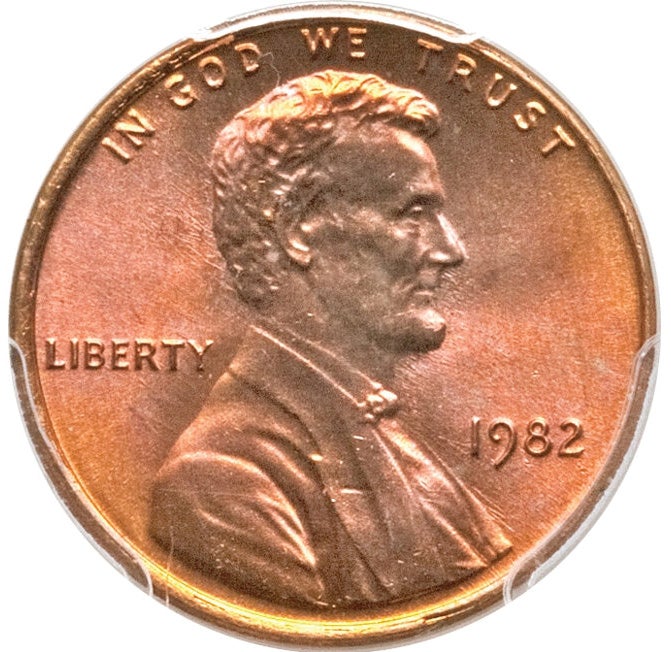
1982 Lincoln cent varieties, Digi Mart USA News: Coins are not always rare or overlooked, and 1982 Lincoln cents illustrate why they can be interesting for many reasons. Most people believe the Lincoln cent’s composition has basically never changed, except for the 1943 steel cents.
In fact, there were a number of other compositions. From 1944 to 1946, the Mint used an alloy derived from shell casings.
It included a bit of tin, but to the casual observer, the cent appeared to have been restored to its normal composition.
The changes in 1943 opened the door to more experiments with the cent. Until 1962, the composition was 95 percent copper and 5 percent zinc and tin.
The change in 1962 was probably a result of the increased need for cents. It was a small change, as the alloy was set at 95 percent copper and 5 percent zinc.
The elimination of tin helped production, and officials were confident it would have no adverse impact on the ability of the coins to last with substantial wear. The makeup of the cent was subject to economic pressures from rising copper prices.
Officials had several options: discontinue the cent, spend more than one cent to produce each Lincoln cent, or change the composition to keep production cost under face value. The last option seemed to be the best.
In December 1973, the secretary of the Treasury was given the power to change the composition of the cent. The idea at the time seemed to be aluminum.
More than 1 million 1974 aluminum cents were produced, but the price of copper fell and the idea ran into serious opposition. The aluminum cents were destroyed before being released, although a few have survived, as some were given out as samples to officials.
In 1982, however, rising copper prices forced officials into making a decision. The options were the same as in the past.
A Research Triangle Institute report had called for the elimination of the cent, as it was too costly to produce and did not circulate well. Officials balked at the idea, not wanting to be responsible for dumping Abraham Lincoln’s coin and forcing Americans to round purchases.
A composition change was the safest decision. The result was a composition of 97.5 percent zinc and 2.5 percent copper.
The copper was a plating to give the coins a “normal” appearance.
It was another triumph of American engineering, as few noticed the change. In 1982, cents were produced from both the old and new compositions.
The new-composition cents weigh 2.5 grams, as opposed to 3.11 grams for the old composition.
With a composition change, it was only natural to modify the dates. Date modifications in 1960 and 1970 had resulted in small- and large-date cents.
The same thing happened in 1982.
The date modification and composition change resulted in an assortment of 1982 cents. While none are rare, there are Philadelphia 1982 copper large- and small-date cents.
There are also 1982 zinc large- and small-date cents from Philadelphia. Denver produced copper large-date cents, as well as small- and large-date zinc cents.
San Francisco produced a proof.
A collection of 1982-dated cents is a nice assortment. For those wanting a bit of history, a 1982 collection is a good idea, and at today’s prices, you cannot go wrong.