Australian employers job cuts and the economy, Digi Mart USA News (Australia): Job cuts across several Australian sectors, from banking and mining to digital services, have raised concerns about the broader economy. Last week, digital design company Canva announced it will cut or relocate more than 1,200 jobs, or 22 per cent of its workforce, in what was described as its first restructuring in 13 years.
Just a day later, gas company Woodside Energy announced it would cut at least 500 jobs globally as part of a cost-cutting process, with 80 per cent of its workforce based in Australia. On the same day, the country’s iconic retailer David Jones announced it had entered voluntary administration.
The job-cutting trend has also reached the banking sector, with National Australia Bank (NAB) announcing plans to cut 2,500 jobs by the end of the financial year in October.
Robert Breunig, an Australian National University public policy economist, told SBS News that the cuts are significant. “In some cases, some of these businesses are shedding,” he said.
“It’s hundreds or even thousands of jobs, and it’s a large fraction of their workforce. But in terms of the number of overall jobs in the economy, it’s still just a relatively small piece of the picture.”
These employers face different pressures. Canva co-founder and CEO Melanie Perkins said in a statement that “new technology is transforming what people can create” and that “small changes won’t be enough”, without directly naming artificial intelligence.
David Jones’s announcement followed years of mounting pressure on traditional department stores from changing shopping habits, online competition and expensive property decisions. NAB blamed challenging economic conditions, technological change, competition and a need to simplify its operating model.
Robert Brooks, a professor in the department of econometrics at Monash University, said each announcement offers different lessons. “Canva is obviously a newer company at a much earlier stage, and it’s working through what its appropriate business model is in a digital transformation setting,” he told SBS News.
“David Jones is a mature company in a mature industry that’s been significantly impacted by technological change and changing people’s retail purchase patterns.”
Brooks said the banking sector is somewhere in between. “They’re clearly in a business model that is being disrupted, but a lot of their business has a tremendous go-forward version,” he said.
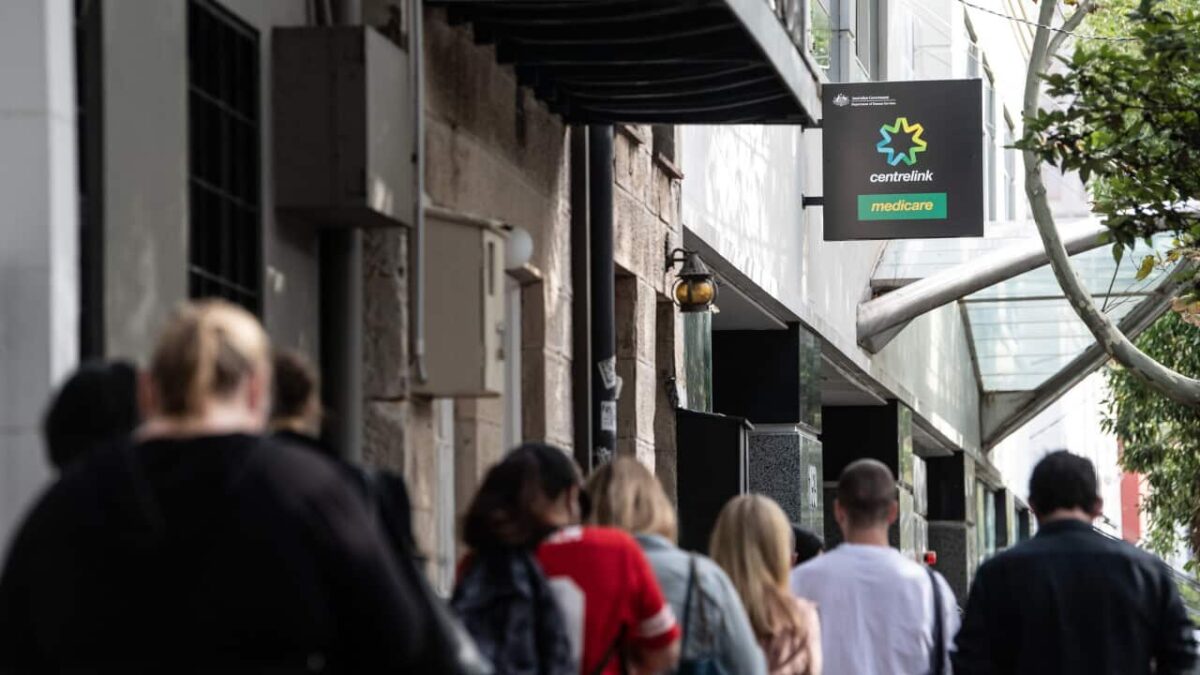
The job cuts have coincided with a rise in Australia’s unemployment rate to 4.7 per cent in September, its highest level since October 2021, according to the Australian Bureau of Statistics (ABS). The figure, along with the company cuts, has raised questions about the strength of the job market.
Brooks said the market “has been really resilient up to a point”, but that recent data suggests it has become slightly less resilient. He said people should watch the current job market “incredibly carefully”, though there is not yet enough information to show that it has started to crack.
The ABS figures showed almost 40,000 people lost their jobs in September, while 732,000 people were unemployed nationwide. Breunig said Australia’s job market is not doing as well as a year ago, but the economy remains fairly robust.
“We often talk about job losses because those are the things that get the media attention, but there are also thousands of jobs that are created every day. And Australia does have a very dynamic small business sector.”
He warned that rising unemployment could affect the economy as a whole. “It does put the government in a difficult position because they’re gonna have to pay more in income support payments to people.
They’re also gonna get less tax revenue from fewer workers,” he said.
More job losses are expected in the coming months following the Reserve Bank’s rate hike in November, from 4.6 per cent to 4.85 per cent, the highest since 2008. Economists and social services groups are bracing for unemployment to rise, as higher interest rates generally lead to higher unemployment.
Breunig said higher mortgage costs make people feel poorer, reducing spending and rippling through to lower employment. He added that in the long term, AI is likely to displace jobs and create others, but in the short to medium term it is also likely to push unemployment up.
Persistently higher unemployment could affect the entire economy and potentially lead to a recession, which the RBA has said it wants to avoid. One recession indicator, the ‘Sahm rule’, considers a recession underway when the three-month average unemployment rate is at least 0.5 per cent higher than its lowest level in the past year.
The RBA adjusts this threshold to 0.75 per cent for Australia. Here, the jobless rate averaged 4.63 per cent from July to September, up from 4.17 per cent between December and February, a 0.46-percentage-point increase that falls short of that threshold.
Last week, while announcing the fifth rate rise of the year, RBA governor Michele Bullock said rate increases will “make people feel like it’s a recession because they feel poorer”. She added that the bank “is not looking to tip the economy into a recession if we can avoid it”.
Rising unemployment could influence a future rate cut. Potential employment effects were among the factors the RBA board considered at its last meeting, when six members voted to raise rates and three voted to leave them unchanged.
Brooks said part of the split reflected questions about whether the rate increase would cause “a large spike in unemployment that the labour market can’t quite deal with”. He said the bank would need to review the data.
“More data that tells us that unemployment is continuing to rise would suggest that we wouldn’t wanna push too hard further on contractionary monetary policy.”